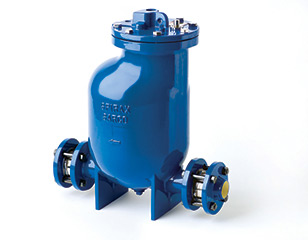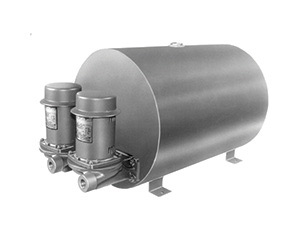
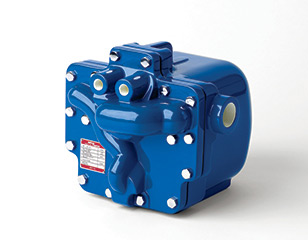
The APT10 / APT14 is an automatic pump trap: a receiver that fills with condensate and then uses steam or compressed air pressure to push it out to a higher point. There is no motor, no impeller and no cavitation, because the pump never has to handle water at saturation temperature.
That is why pump traps dominate condensate recovery. An ordinary centrifugal pump cavitates when it tries to move condensate at 100 °C or more; a pressure-powered pump simply displaces the condensate with gas pressure, so it can recover heat that would otherwise be dumped.
Design and construction
Cast or stainless receiver with an internal float mechanism that cycles the fill and discharge valves, plus a motive gas connection and non-return valves on inlet and outlet. The APT10 and APT14 cover different receiver volumes and motive pressures within the same working principle.
Key features
- Motive power from steam or compressed air – no electric motor
- No cavitation when pumping condensate at saturation temperature
- Recovers heat that would otherwise be lost to drain
- Handles variable loads automatically with a float mechanism
- Suitable for hazardous areas and remote locations
- Low maintenance – only valves and float parts wear
Selection and sizing
Size the receiver on the condensate flow in kg/h and the number of cycles acceptable, then confirm the motive pressure can lift the condensate against the total head (static lift plus return main pressure). Two pump traps in parallel are common where the load is high or where continuous discharge is required.
Installation and maintenance
Mount below the equipment drain so condensate flows in by gravity, with a strainer upstream and non-return valves on both connections. Provide the motive gas at the specified pressure, and pipe the discharge to the return main with an air vent at the receiver.
Options and spare parts
Float mechanisms, inlet and outlet valve assemblies, gaskets and non-return valves are available.