
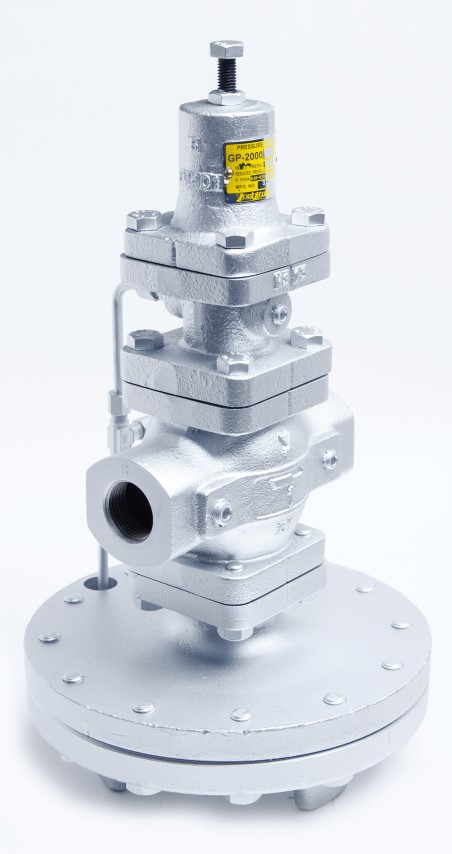
The GP-2000 is a pilot operated pressure reducing valve for steam. A small pilot valve senses the downstream pressure and uses it to load the main valve diaphragm, so the main valve opens and closes with far more authority than a direct-acting regulator can achieve.
The result is a downstream pressure that stays close to set point across the whole flow range – the requirement when steam is let down from a high pressure main to feed a process, a heater battery or a lower pressure distribution system.
Design and construction
Main valve with a piston or diaphragm actuator loaded by a pilot valve, plus a strainer on the pilot supply and adjusting screws for set pressure. Because the pilot does the sensing, the main valve can be large while the control error stays small, and the valve closes tight when there is no demand.
Key features
- Pilot operation gives accurate control across the full flow range
- High capacity in a compact body
- Tight shut-off at zero demand – no continuous steam loss
- Adjustable downstream set pressure on site
- Available with safety valve and separator as a reducing station
- Simple maintenance with replaceable pilot and main valve parts
Selection and sizing
Size the valve on the maximum flow at the minimum inlet pressure, and check the turndown against the minimum flow. Confirm the inlet pressure range, the required downstream pressure, the maximum capacity in kg/h and whether a safety valve is needed downstream. A reducing valve alone does not protect downstream equipment – add a safety valve if the downstream rating could be exceeded.
Installation and maintenance
Fit a separator and strainer upstream, and a safety valve downstream of the reducing valve. Allow straight pipe runs and provide a bypass for maintenance. Set the downstream pressure with the plant running, then lock the adjusting screw and record the setting.
Options and spare parts
Pilot valve assemblies, diaphragms, main valve seats and springs are available as spares.


